Narrow the scope
At the coaching moment, it was mentioned that the project should be smaller, because now I want too much.
I wrote down for myself what I had in mind (see blogpost: Research question) and tried to list the different elements that belonged to the project.
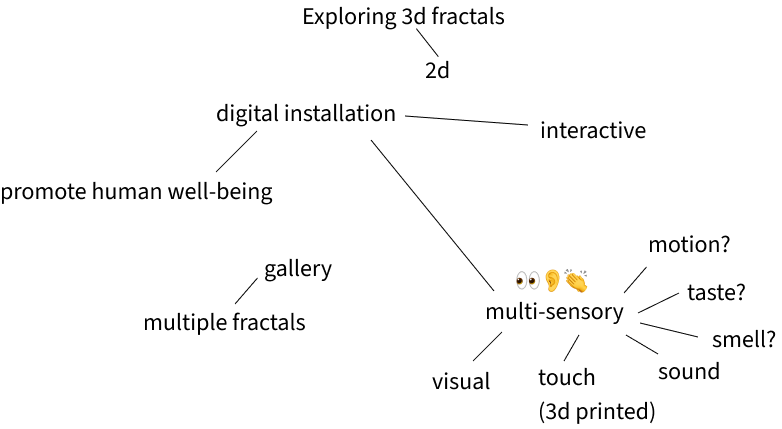
- multi-sensory -> focus on one sense?
- tactile: 3d printed -> Why? I always wanted to 3d print something, but perhaps this might turn into too much of a side project of a passion project and might not fully align with the main focus.
- multi-sensory installation (= combine different senses in one installation) -> too wide range, hard to combine things in the given timeframe if you have to learn it.
- pressure -> only focus on some items, you can’t do everything! => (small) demos in process
- 3d fractals -> start understanding fractals, start 2d and then 3d. => But multiple fractals exist-> on which one do I focus?
- gallery -> it would be nice to show multiple fractals in the final result -> too much
- promote human well-being -> nice side effect, not much done with it now. Is also something extra on top while we should make it smaller.
Conclusion:
I can either focus on one fractal (by looking at several first and then choosing one) and focus on different senses and software, or I can focus on one sense with multiple fractals. I think the first option is more interesting, so I choose that. Then I can divide the project into smaller pieces in my schedule, as discussed during the coaching moment: for example, three days focusing on the visual, then four days on the auditory, and then a few days on the tangible.
Below I list what I would like to do. - Exploring fractal formulas
- briefly review the different formulas that fractals are based on before choosing one to work further.
- Coding in 2D and then 3D
- Exploring different software
- I want to discover and experiment with different software. I’m curious if I can achieve the same visual result in different software and how the code I write differs per software.
- Audio integration
- I want to experiment how sound can go together with the visual aspect of the fractal.
- 3D printing
- Although I would like to 3D print, I think it would feel too much like a separate aspect of the project. I could possibly try to encode the fractal and generate a file type suitable for the 3D printer, but this would be too disconnected from the bigger picture of the project. It would then feel more like separate demos, without an overarching goal.
Fractal applications
Fractals have multiple applications in different domains:
- 🏡 Architecture
- 💊 Medicine: images - the use of MRI and CT scans for diagnosing diseases, identifying irregular heart beats, detecting tumors…
- 💶 Economics: analysing market fluctuations
- 💻 Development & Computer science
- Creating textures and landscapes for video games and films that look extremely realistic
- Jpeg compression → wasn’t a big hit
- Used in AI: image processing, speech recognition and machine learning.
- 🧮 And, of course, Mathematics!
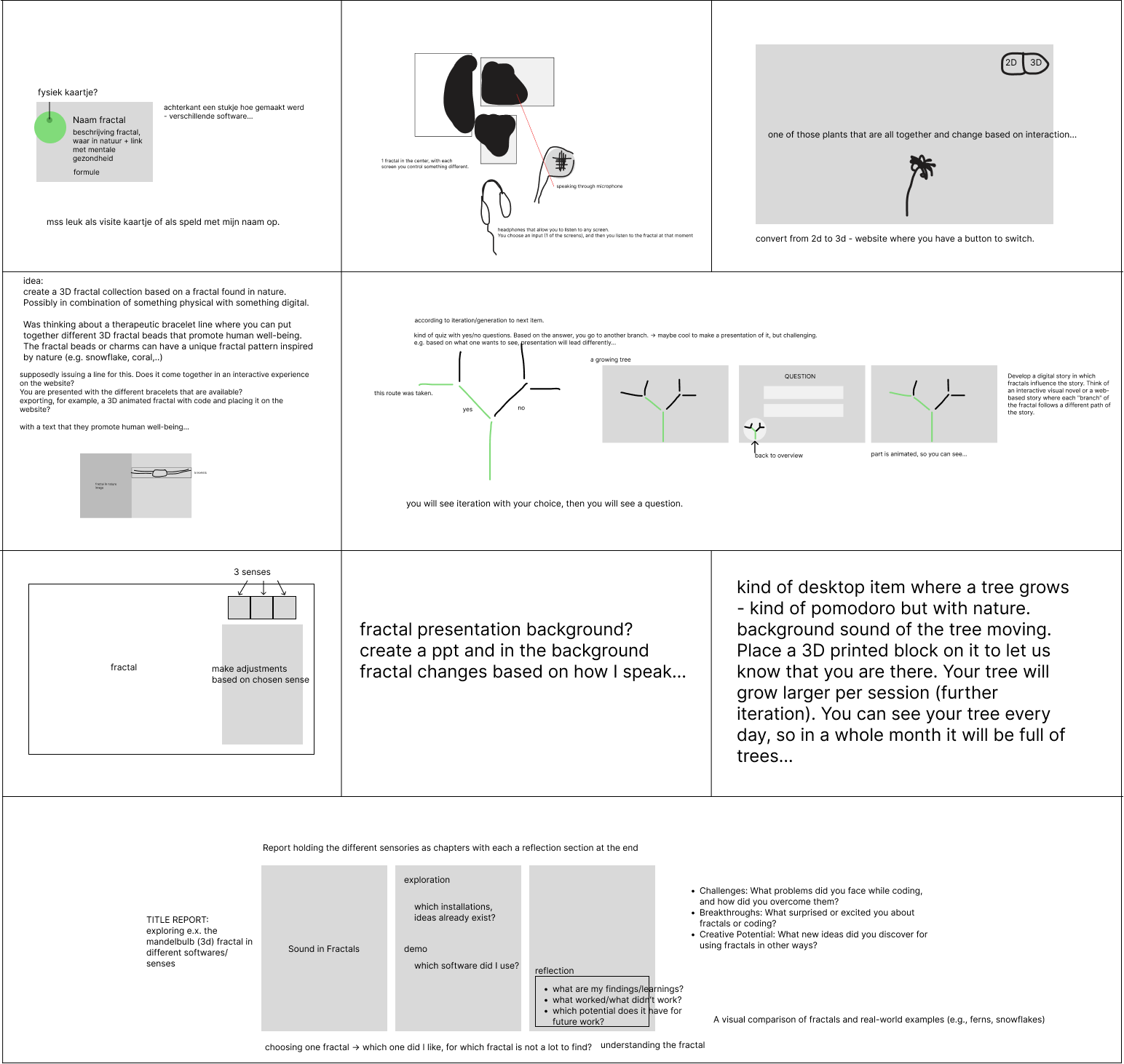
I already found some inspirational projects and will now break them down by sense.
| Fractal project | 👂sound | 👀visual | 👏touch |
|---|---|---|---|
| Not digital: https://www.seriouswhimsy.com.au/projects/2019/1/1/chorus-three-sonic-objects | x | x | x |
| Based on how loudly you say something (voice (sound) as input), the tree changes real-time to a further iteration: https://www.instructables.com/Speech-Tree-Text/ | x | x | |
| Creating sounds in fractals by clicking on the mandelbrot (2d): https://www.youtube.com/watch?v=GiAj9WW1OfQ&list=PLh9DXIT3m6N7n4R60eJGPPPnn5LvTXQLY&index=8 | x | ||
| 3D kaleidoscope: https://www.youtube.com/shorts/OXKKVHDkEA0 | x | ||
| Installations using Kinect (depth calculating). People have to make moves to change the fractal: https://www.youtube.com/watch?v=Qkwz6ZAgznQ, https://www.youtube.com/watch?v=sasvx7GcIT4 | x | ||
| Julius Horsthuis - a fractal artist who makes VR movies, his work is in global temporary galleries and festivals: https://www.julius-horsthuis.com/ | x | x | |
| Ray marching 3d fractals that animate: https://observablehq.com/@leon196/raymarch | x | ||
| 2d fractal animations: https://andrew.wang-hoyer.com/experiments/svg-animations-src/dist/21/c/ | x | ||
| Dancing fractal in TouchDesigner that responds to sound: https://www.youtube.com/watch?v=bb4sKuAWYio | x | x |
I haven’t found any fractal projects with scent.
Different fractals
I also noted down some fractals that I have encountered:
- mandelbrot set (2d) ↔ mandelbulb (3d), mandelbox
- julia set
- menger sponge
- barnsley fern
- newton fractals
- trees (L-system)
- koch curve, koch snowflake
- cantor set
- sierpinski triangle, sierpinski carpet
- burning ship fractal (weird shape)